

Continental Drift Lab Answer Key
5.5: Continental Drift
- Page ID
- 2520
INTRODUCTION
The continental drift hypothesis was developed in the early on role of the 20th century, more often than not by Alfred Wegener. Wegener said that continents motility effectually on Globe's surface and that they were in one case joined together as a unmarried supercontinent. While Wegener was alive, scientists did non believe that the continents could motion.
THE CONTINENTAL DRIFT IDEA
Find a map of the continents and cutting each ane out. Meliorate all the same, use a map where the edges of the continents show the continental shelf. That'south the true size and shape of a continent. Can yous fit the pieces together? The easiest link is betwixt the eastern Americas and western Africa and Europe, but the remainder can fit together too (figure ane).
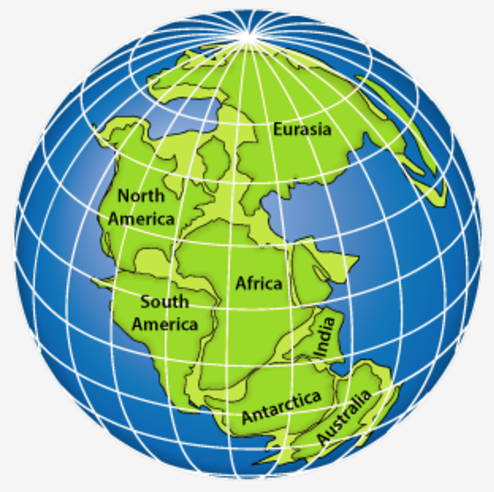
Effigy i. The continents fit together like pieces of a puzzle. This is how they looked 250 million years ago.
Alfred Wegener proposed that the continents were once united into a single supercontinent named Pangaea, meaning all world in ancient Greek. He suggested that Pangaea broke upwardly long ago and that the continents so moved to their current positions. He called his hypothesis continental drift.
EVIDENCE FOR CONTINENTAL Drift
Besides the way the continents fit together, Wegener and his supporters collected a great deal of evidence for the continental drift hypothesis.
- Identical rocks, of the same blazon and age, are found on both sides of the Atlantic Ocean. Wegener said the rocks had formed side-past-side and that the land had since moved apart.
- Mountain ranges with the same stone types, structures, and ages are now on contrary sides of the Atlantic Ocean. The Appalachians of the eastern Usa and Canada, for example, are just like mountain ranges in eastern Greenland, Ireland, Corking U.k., and Norway (figure 2). Wegener ended that they formed as a single mountain range that was separated as the continents drifted.
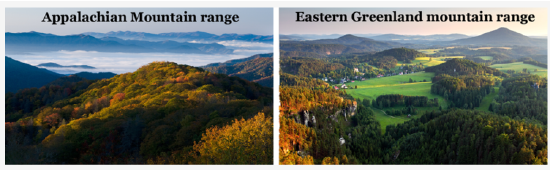
Figure 2. The similarities between the Appalachian and the eastern Greenland mountain ranges are evidences for the continental drift hypothesis.
- Ancient fossils of the same species of extinct plants and animals are constitute in rocks of the same historic period but are on continents that are now widely separated (figure 3). Wegener proposed that the organisms had lived side by side, but that the lands had moved apart after they were expressionless and fossilized. He suggested that the organisms would not have been able to travel across the oceans.
- Fossils of the seed fern Glossopteris were also heavy to be carried so far by wind.
- Mesosaurus was a swimming reptile simply could only swim in fresh water.
- Cynognathus and Lystrosaurus were state reptiles and were unable to swim
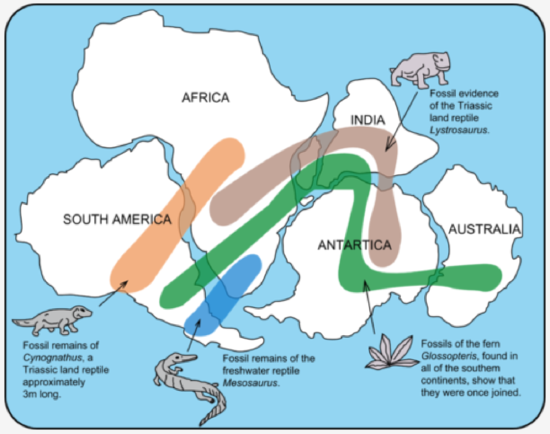
Effigy iii. Wegener used fossil evidence to back up his continental drift hypothesis. The fossils of these organisms are found on lands that are now far apart.
- Grooves and rock deposits left by ancient glaciers are found today on different continents very close to the equator. This would indicate that the glaciers either formed in the middle of the ocean and/or covered virtually of the Earth. Today glaciers only form on state and nearer the poles. Wegener idea that the glaciers were centered over the southern land mass shut to the Due south Pole and the continents moved to their present positions later.
- Coral reefs and coal-forming swamps are found in tropical and subtropical environments, simply aboriginal coal seams and coral reefs are found in locations where it is much too cold today. Wegener suggested that these creatures were alive in warm climate zones and that the fossils and coal afterwards had drifted to new locations on the continents.
Take a look at this animation showing that Earth's climate belts remain in roughly the aforementioned position while the continents move and this animation showing how the continents divide up.
Although Wegener's bear witness was sound, most geologists at the time rejected his hypothesis of continental drift. Why do y'all call up they did not accept continental drift?
Scientists argued that there was no way to explicate how solid continents could plough through solid oceanic chaff. Wegener'south idea was nearly forgotten until technological advances presented even more testify that the continents moved and gave scientists the tools to develop a mechanism for Wegener'southward drifting continents.
MAGNETIC POLARITY Testify
Puzzling new show came in the 1950s from studies on the Globe's magnetic history (figure 4). Scientists used magnetometers, devices capable of measuring the magnetic field intensity, to expect at the magnetic properties of rocks in many locations.
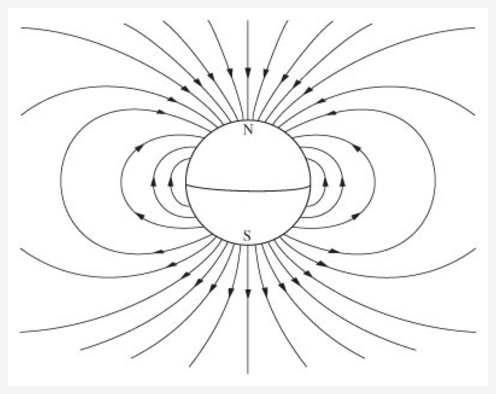
Figure 4. Earth's magnetic field is like a magnet with its due north pole nigh the geographic North Pole and the south pole near the geographic South Pole.
Magnetite crystals are like tiny magnets that point to the north magnetic pole as they crystallize from magma. The crystals tape both the management and strength of the magnetic field at the time. The direction is known as the field's magnetic polarity.
Magnetic Polarity on the Aforementioned Continent with Rocks of Different Ages
Geologists noted important things near the magnetic polarity of different aged rocks on the aforementioned continent:
- Magnetite crystals in fresh volcanic rocks point to the electric current magnetic north pole (figure 5) no matter what continent or where on the continent the rocks are located.
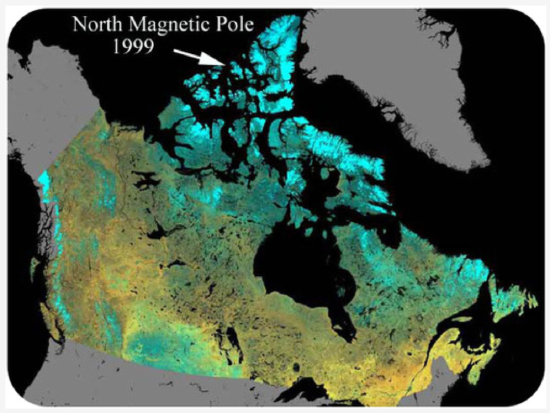
Figure 5. World's electric current n magnetic pole is in northern Canada.
- Older rocks that are the same age and are located on the same continent point to the same location, but that location is non the current northward magnetic pole.
- Older stone that are of different ages practice not point to the aforementioned locations or to the current magnetic due north pole.
In other words, although the magnetite crystals were pointing to the magnetic n pole, the location of the pole seemed to wander. Scientists were amazed to find that the north magnetic pole changed location through time (figure 6).
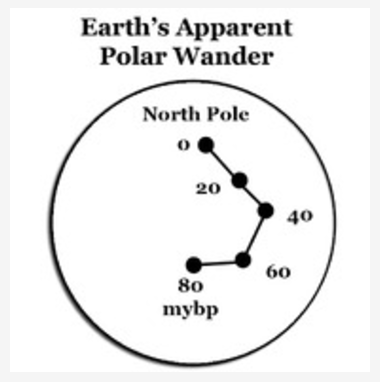
Effigy half-dozen. The location of the due north magnetic north pole 80 million years before present (mybp), then 60, forty, twenty, and now.
There are 3 possible explanations for this:
- The continents remained fixed and the north magnetic pole moved.
- The north magnetic pole stood nonetheless and the continents moved.
- Both the continents and the northward pole moved.
Magnetic Polarity on Different Continents with Rocks of the Same Age
Geologists noted that for rocks of the same age but on different continents, the footling magnets pointed to different magnetic n poles.
- 400-million-twelvemonth-erstwhile magnetite in Europe pointed to a different north magnetic pole than the aforementioned-anile magnetite in North America.
- 250 million years ago, the north poles were besides different for the two continents.
The scientists looked over again at the three possible explanations. Only i can be correct. If the continents had remained fixed while the north magnetic pole moved, there must have been 2 separate north poles. Since there is only one north pole today, the only reasonable explanation is that the n magnetic pole has remained stock-still merely that the continents have moved.
To test this, geologists fitted the continents together every bit Wegener had done. It worked! There has only been one magnetic north pole and the continents have drifted (figure 7). They named the phenomenon of the magnetic pole that seemed to motion but really did not credible polar wander.
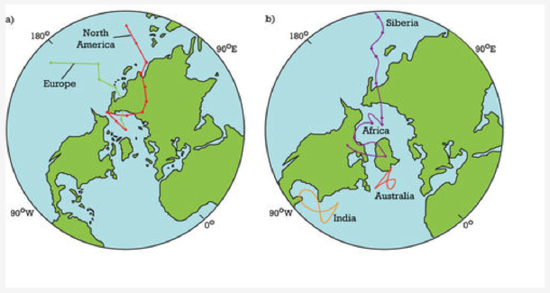
Figure seven. On the left: The apparent northward pole for Europe and North America if the continents were ever in their current locations. The two paths merge into one if the continents are allowed to drift.
This testify for continental migrate gave geologists renewed interest in understanding how continents could motion almost on the planet's surface.
LESSON SUMMARY
- In the early part of the 20th century, scientists began to put together evidence that the continents could movement around on Globe's surface.
- The evidence for continental drift included the fit of the continents; the distribution of aboriginal fossils, rocks, and mount ranges; and the locations of aboriginal climatic zones.
- Although the evidence for continental drift was extremely stiff, scientists rejected the thought because no machinery for how solid continents could move around on the solid earth was developed.
- The discovery of apparent polar wander renewed scientists interest in continental drift.
REFLECTION QUESTIONS
- What skill does this content help you lot develop?
- What are the key topics covered in this content?
- How can the content in this section assistance you lot demonstrate mastery of a specific skill?
- What questions do you lot accept about this content?

Continental Drift Lab Answer Key,
Source: https://geo.libretexts.org/Bookshelves/Geology/Book:_Fundamentals_of_Geology_%28Schulte%29/05:_Plate_Tectonics/5.05:_Continental_Drift
Posted by: finleysionuirt.blogspot.com
0 Response to "Continental Drift Lab Answer Key"
Post a Comment